MANY of us are apt, not without some reason, to regard the world we live
in as the centre of the universe, and to look upon the sun, the moon,
and the stars as objects placed in the heavens for the special benefit
of the human race. That the earth is but a minute object in the Cosmos;
that it forms one of a number of bodies, many of them larger than
itself, revolving around their central luminary, the sun; that there
exist in the realms of space myriads of similar suns, centres themselves
of other solar systems; that millions of planets, which we cannot see,
are inhabited with races of intelligent beings -- these are facts of
which almost everybody must cognisant, but on which few bestow much time
or thought.
Astronomy teaches that, just as our solar system had a beginning, so it
must have an end, and that, as at one time life was impossible upon the
earth, so there will come a time when man will no longer be able to
exist.
Science, cold and calculating, has foretold the physical end of the
world -- has prophesied the destruction of the globe and all its
contents.
Birth, life, death -- it has been well been said --appear to be the rule
of the universe at large, as well as in our own little corner of it.
Suns and planets are evolved, they flourish, and at length decay; and
new suns and systems will arise to take their places.
The "End of the World" may be taken in two different senses, as meaning
either the annihilation of our planet by sudden catastrophe, or by
gradual decay, or else the disappearance of human life from the face of
the globe, owing to some state of circumstances, possible, at any rate,
if not probable.
It is our purpose in this article briefly to consider some of the
opinions held by men of learning and repute regarding the end of the
world, and to emphasise the lesson taught by Nature that the individual
counts for nothing in the history of the race, the race for nothing in
the life of the planet, and the planet for nothing in the duration of
the Universe.
Very many derive their inspiration on this absorbing subject from the
Bible, where we read: "The day of the Lord will come as a thief in the
night; in the which the heavens shall pass away with a great noise, and
the elements shall melt with fervent heal, the earth also, and the works
that are therein, shall be burned up."
Every child knows that water was the agency of destruction in the
ancient world, and that the rainbow was placed in the sky as a token
that life should never be destroyed by this cause again. All through the
Bible we may trace the prophecy that the world would come to an end by
being consumed with fire.
It is out of our province here to touch on the signs given in the Bible
whereby the arrival of the last day may be predicted. Certain preachers
have brought great ridicule on themselves by their very certain
statements on this point, but they seem little abashed when their
prophecies do not come true, and merely alter dates and times to suit
the next occasion.
Many readers will call to mind a rhyme which at the time terrorised the
minds of hundreds of thousands of young and ignorant people --
"The world unto an end shall come
In Eighteen Hundred and Ninety-One."
The date has been often changed and will (it may safely be said)
continue to be changed for the benefit of future generations. It is
curious to notice that hardly two philosophers agree as to the manner in
which the end of the world may be expected to arrive. Some put their
faith in a celestial catastrophe so terrible as literally to wipe our
earth out of existence, while others prefer to believe that though man
may no longer be able to exist, the world will still continue its
appointed motions.
Lord Kelvin startled us not long ago by affirming that there was only
oxygen in the atmosphere sufficient to last mankind for some 300 years,
and that the world was doomed to die of suffocation. Everyone knows that
in an atmosphere devoid of oxygen no animal being can live for long.
Put a mouse under an air-tight glass containing some burning substance
that exhausts the oxygen, and it will be speedily suffocated. Thus will
it be (so says Lord Kelvin) with man, who is himself lighting the fires
for the suffocation of his progeny.
On an average it requires three tons of oxygen to consume one ton of
fuel, and the oxygen that exists in our atmosphere is practically all
the supply available for the purpose. As shown by the barometer the
average weight of the air is 14.9 pounds to the square inch, which gives
a total weight for the earth of 1,020,000,000,000 tons of oxygen. At
the rate of three tons of oxygen to one ton of fuel, the weight of fuel
which can be consumed by this oxygen is 340,000,000,000 tons.
Now to see how the oxygen can keep pace with the fuel. The whole world
consumes about 600,000,000 tons of coal a year, and to this must be
added the consumption of oxygen by wood and other vegetable substances
which raises the equivalent coal consumption of the world to not less
than 1,000,000,000 tons a year.
Thus, even at the present rate of fuel consumption there is only oxygen
to last 340 years, and long before this time the atmosphere would have
become so vitiated with carbonic acid gas, and so weakened in oxygen,
that either we should have to emigrate to some other sphere, or else
give up the habit of breathing altogether.
Following in Lord Kelvin's footsteps, Professor Rees, a prominent
American scientist, has been going further into the question of the
exhaustion of the air supply of the world. He gives definite warning of
the coming "failure" of the air.
"'Free as the air we breathe,'" he writes, will, in the distant future,
become an out-of-date, misleading expression. Air will no longer be
free, for it will be manufactured and sold like any other necessary.
Those who will not work for their daily air supply, and who cannot
afford to buy it, will perish, for Nature will have exhausted her
supply. The artificial air will be stored up in enormous reservoirs, and
to these receptacles applicants will come for their daily supply of
oxygen. This will then be carried home and doled out to the family as
part of the day's means to support life. The manufactured oxygen will be
breathed in as a diver inhales the air supplied him when he sinks
beneath the waves.
"'Died from air starvation' will be a connmon verdict in the coroners'
courts of the future, for 'no money, no air,' will be the rule of life.
The wealthy will gain a reputation for charity by free gifts of air to
the aged poor at Christmas time. Men and women will no longer be able to
look at each other with eyes of love, for everyone will be clothed in a
great air helmet, like a diver of to-day."
There is, however, a silver lining of hope fringing these gloomy clouds
of speculation. Lord Kelvin himself is not wholly a prophet of evil,
neither are his views of an entirely pessimistic nature. He looks to the
agriculturist to improve his methods, so that the plant life on the
globe may be able to absorb the surplus carbonic acid gas and to release
sufficient new oxygen to cope with the growing consumption of fuel.
Those sources of Nature at present allowed (except in a few instances)
to run to waste -- the tides, the ceaseless movement of the waves,
waterfalls, solar energy, the wind, the ether, atmospheric electricity
-- all these in times to come will be made to supply the energy that we
require for daily needs. If this be the case, we shall not die of
suffocation after all.
But though we may escape suffocation, there is yet the chance that some
day there will be no air for poor humanity to breathe. Mr. Nikola Tesla,
of world-wide fame, announces that if we are not cautious we may set
light to the atmosphere with our electric discharges of a "few million
volts."
He suggests that "periodical cessations of organic life on the globe "
might have been caused through the ignition of the air by flashes of
lightning. Electricity is, indeed, a mysterious force, and Mr. Tesla's
warning certainly appeals to the imagination. It would be interesting to
know if the distinguished American electrician has a remedy to propose.
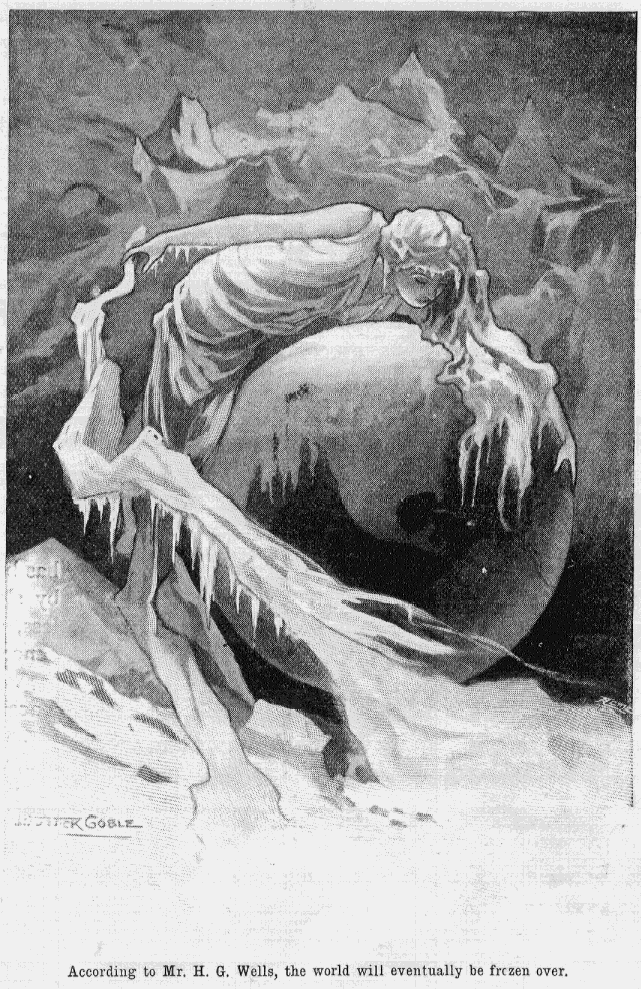
Mr. H.
G. Wells has drawn in his romance, "The Time Machine," a strangely
impressive picture of the end of the world as he conceives it. The last
man, according to his conception, freezes to death, and life becomes
unsupportable on our planet, not because of great heat, but rather from
intense cold.
Mr. Wells has the testimony of science on his side. and has indeed based
his assumptions on the learned treatises of Professor J.H. Darwin.
By dint of laborious calculation it has been shown that the sun's heat
is by slow degrees becoming less and less, and that some day, long years
hence, the sun will no longer give out the warmth necessary for human
existence. Mounting his "time machine," Mr. Wells plunges off into the
future, and, when he has journeyed millions of years hence, he finds a
slowly freezing world in which man and beast fail to find the means of
subduing the pangs of hunger or of protecting themselves from the cold.
The sun hangs in a grey sky -- a pale, weird, ash-coloured ball,
incapable of supplying light and warmth.
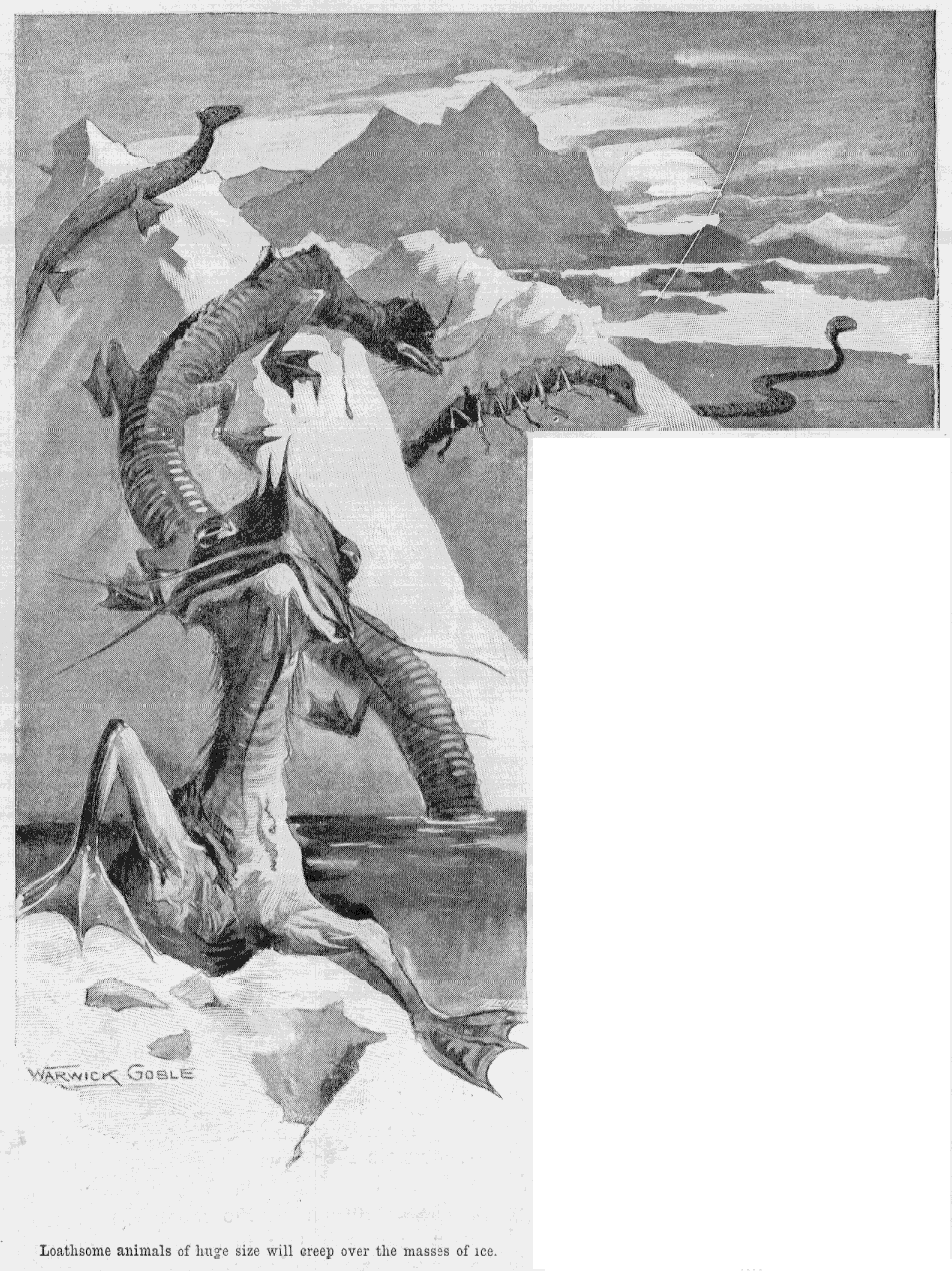
Loathsome animals of huge size, brought into existence by the altered condition of affairs, creep over the masses of ice
and crawl over the frozen seas and lakes. Little by little all trace of
vegetation disappears -- a steady snowstorm settles down over the
earth, and our planet revolves in space for a short time only to fall a
frozen mass into the bosom of the dying sun.
That the solar temperature is declining is, I think, universally
conceded by astronomers, who also admit the steady contraction of our
great luminary. The sun is now apparently contracting at the rate of 220
feet per annum, and if we look forward through a vista of many
thousands of years we see the sun ever diminishing in dimensions. There
is, however no cause for immediate alarm, and millions of years must
elapse before our sun will have vanished from the heavens.
Looking back at the past history of the earth the astronomer pictures a
time when the earth was a sun. Coming down the ages he shows us a globe
whose condition resembles that of Jupiter and Saturn, planets at the
present time with dense atmospheres still loaded with the waters which
are to form their future oceans. Peering into the future he recognises
in the moon's actual condition a stage through which our planet will
assuredly have to pass.
The earth's inherent heat must pass away, the life on her surface slowly
disappear, until she becomes made up, as we believe the moon to be, of
desert continents and frost bound oceans, lifeless as at the beginning
of her history, but no longer -- as Mr. Proctor put it -- "possessing
that potentiality of life which existed in her substance before life
appeared upon her surface. Long as has been, and doubtless will be, the
duration of life upon the earth, it seems less than a second of time
compared with those two awful time-intervals, one past, when as yet life
had not begun; the other still to come, when all life shall have passed
away."
There are writers who combat the theory that all orbs in space tend
towards death and declare that this seeming tendency will be
counterbalanced by some restorative forces.
Scientific men, however, reply that they are at present unaware of any
such forces, and that in the light of their present knowledge every sun
and every planet must be slowly yet surely wasting away.
Reference has been made to the possible annihilation of our planet by
some dire catastrophe. One of the supporters of this theory is Professor
Falb, a well-known astronomer, who prophesied the destruction of the
world on November 13th, 1899, through collision with a comet known as
Biela's. On the 29th of October, 1899, came a telegram from Santiago,
Chili, announcing that Biela's comet had been observed from there and
was visible to the naked eye. This announcement following on Prof.
Falb's prophecy actually caused no little dismay among the poorer
classes of the Continental peasantry, though in England and America
little alarm was felt. Needless to state, the 13th of November came and
went without the occurrence of any untoward event.
This is not the first time that this particular comet has been credited
with being the instrument by which the Creator was to bring to a
conclusion the existence of mankind on earth.
Between 1828 and 1832 it was generally prophesied that Biela's comet
would come into collision with the earth during the latter year (the
year of its first return after discovery), and there is reason to
believe that a good deal of alarm was caused by such assertions.
The history of this comet may be told in a few words. On February 27th,
1826, M. Biela, in Bohemia, discovered a faint comet whose orbit -- or
path round the sun -- was traversed, he calculated, in about six and
three-quarter years. It was found that in 1832 this comet would pass
within 20,000 miles of the earth's orbit; but, as the earth would not
reach that particular point till one month after the comet had passed
it, no danger to the world need have been apprehended. The assurances of
the astronomer failed, however, to satisfy the minds of many ignorant
and unscientific persons who pretended to be greatly alarmed at the
imminent destruction of our planet.
Astronomers predicted that Biela's comet would be visible at intervals
of six and three-quarter years. It returned regularly up to 1846, when
it appeared divided into two distinct comets. Such a celestial
apparition had never been observed before, and astronomers viewed it
with the keenest interest and excitement. On January 14th the distance
between the two bodies was 177,000 miles, and this was increased on
February 23rd to 191,000. On the 22nd of April the comets had
disappeared.
In 1852 they returned, and the distance between them now was 1,624,000
miles, and, as neither contained a proper "nucleus," it was decided that
they were in process of disintegration. Since 1852 the two comets have
never been seen again, and since 187 Biela's comet has not been seen,
and astronomers conclude that it must have undergone the fate of all
comets which approach the sun frequently and nearly -- they either fall
into its vast mass and are consumed like moths around a candle, or else
they waste their substance in forming tails of such extreme length that
they become so attenuated as to be no longer visible.
But, the reader may ask, are there not other comets against which the
earth is likely to collide with disastrous consequence to herself and to
her inhabitants ? It is estimated that there are about 17,500,000
comets in connection with the solar system alone. Is it not possible
that any of these may come into contact with the earth?
In 1832, our planet is known to have actually passed through the tails
of comets, hut nothing came of it. What would happen if we unfortunately
encountered the actual nucleus of one is a question more easily asked
than answered.
Such a catastrophe, though possible, is exceedingly remote, however.
Another question now arises: may not the extinction of the human race be
brought about by some lower order usurping dominion over and finally
destroying mankind ?
At first sight the idea seems absurd. Man, the lord of creation, to be
driven off the globe by the creatures over whom he has so long held
dominion! Preposterous! Let us see what science has to say to this.
Countless ages ago in the world's past history there was a time when
huge monsters, both on land and sea, were common. These reigned supreme
for a time, only to succumb at length and disappear. Many species even
within our own time have become extinct; can man then always hope to
have the preeminence?
"When once a type is gone," said the late Mr. J. F. Nesbit, "Nature
never renews it. So infinite are her resources that no pattern, no
number of patterns, matters. And it may be that man, a late arrival, is
destined to a far shorter use of the earth than the cockroach or the
lobster."
Not over flattering to human vanity, but nevertheless true!
It is conceivable that changes of climate, and gradual developments and
modifications of which we know little, might concur in bringing some
land species into dangerous prominence.
The vivid imagination of Mr. H. G. Wells, ever ready -- like the fat boy
in Pickwick - to make our flesh creep, once pictured a world devoured
hy ants! We have all read of the migratory ants of Central Africa,
against which no man can stand. On the march they swiftly clear out
whole villages, drive men and animals before them in headlong rout, and
kill and eat every living creature they can capture.
At present they are kept under by animals which prey on them, but supposing these checks to be removed!
We know how easy it is to disturb Nature's balance; rabbits introduced
thoughtlessly into Australia and Californlia rapidly became a serious
pest; sparrows have in many cases brought ruin to the farmers;
hyacinths, planted in Florida rivers, so multiplied that navigation soon
became impossible.
Nature, again unassisted by man, sometimes produces what we call plagues
of certain species. Must we then not allow the possibility of the
extinction of man by the enormous increase and spread of a lower order?
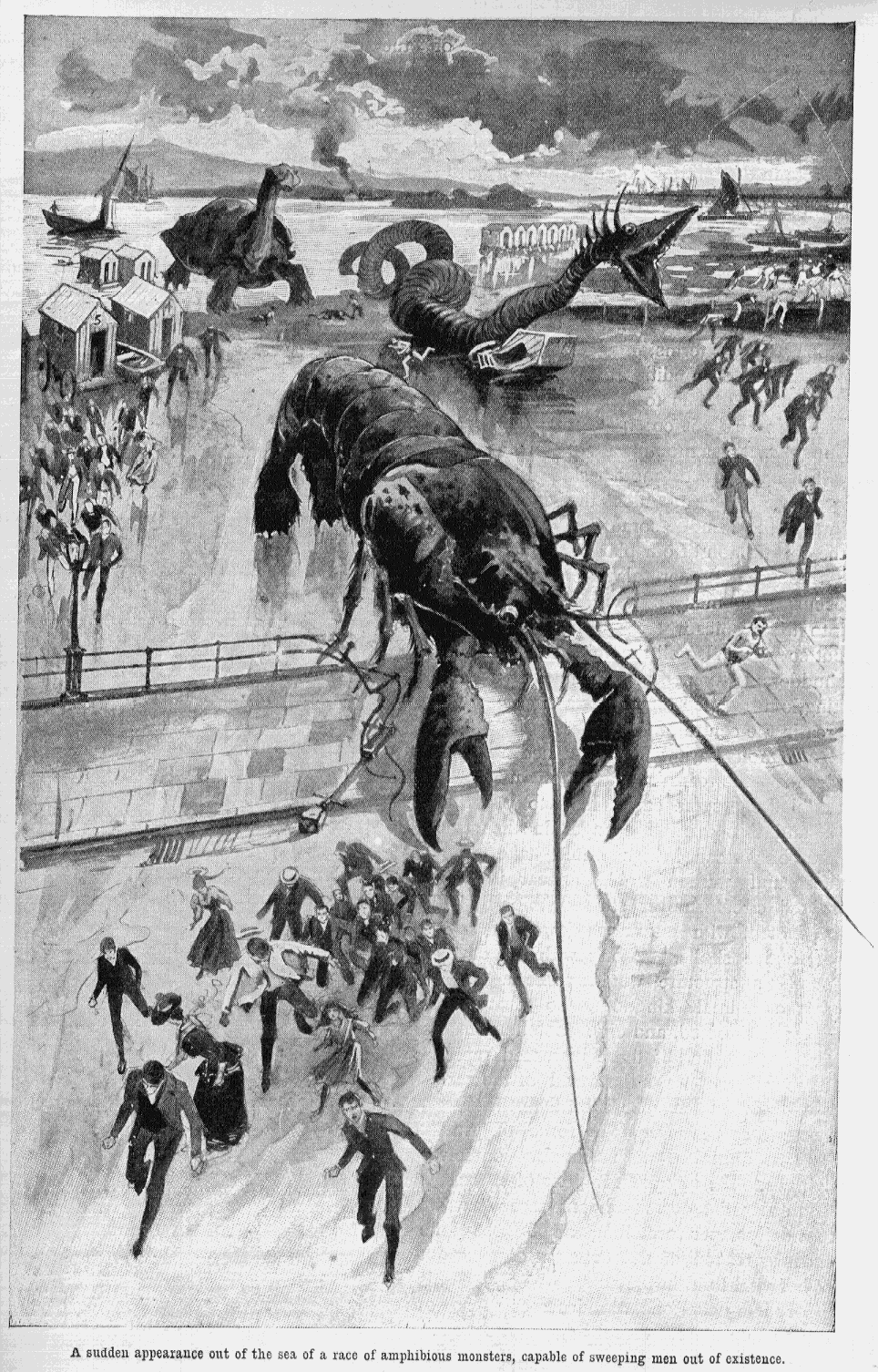
If the reader be still unconvinced let him turn to Mr. Wells' picture of the sudden
appearance out of the sea of a race of amphibious monsters, capable of
sweeping man and all his contrivances out of existence.
Fossil remains of crabs, 6ft. in length, have been discovered, and such
enormous creatures might -- owing to some cause or other -- multiply
exceedingly.
If we imagine a shark that could raid out upon the land, or a tiger that
could take refuge in the sea, we should have a fair suggestion of what a
terrible monster a large predatory crab might prove. And, so far as
zoological science goes, we must, at least, admit that such a creation
is an evolutionary possibility.
Then there are the cuttlefish, the octopus, and other denizens of the
deep, any of which might conceivably grow in numbers, and extinguish
man. And even if we escape death from monsters, there is the chance of
our falling victims to those invisible enemies. the insidious microbes.
At present, it is true, conditions do not favour their rapid spread, but
some radical change in the climate might flood the world with
death-dealing micro-organisms. The fact is, we know little about the
origin of diseases, and why at certain seasons certain epidemics arise.
The bacillus of plague, of influenza, of cholera, of typhoid, or any
other disease propagated by germs, finds that the climatic or
atmospheric conditions are favourable, and promptly proceeds to
multiply, and, once it had a free run, it could destroy the entire human
race in a month.
Turning now to another side of the question, we may consider the
condition of man in the event of some radical change in the constitution
of our planet. Suppose another glacial epoch should occur, would man
survive ? He might retreat into the tropics where ice has never been;
but so would also all the animal life, and one shudders to contemplate
the entire animal kingdom huddled together in a circumscribed area in
the centre of the earth.
A famous savant has imagined that the force of the earth's gravitation
might be doubled by some cause hitherto undreamt of, and that marked
changes in the structure of human beings would take place. Men and women
would appear in these altered circumstances stunted, thick-limbed,
flat-footed, with enormous jaws underlying diminutive skulls. Along with
the change in man's structure would come a change in the animal
kingdom, so that four-footed, six-footed, and eight-footed monsters
would arise, and if these increased rapidly, they would soon rid the
world of their two- footed adversaries. Or, if on the other hand,
through some cause, the force of gravity were to diminish, we might find
ourselves flying into the unknown regions of space!
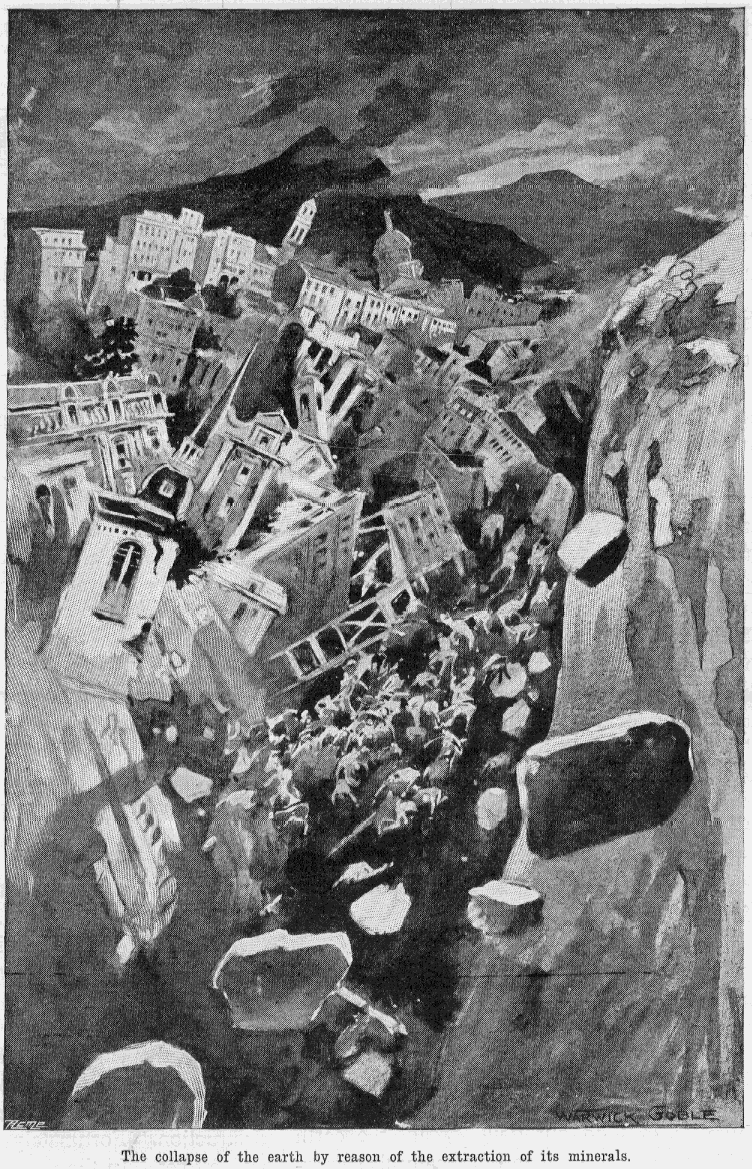
An alarmist correspondent recently wrote to a daily paper foretelling the collapse of the earth
by reason of the constant drawing out of her vital fluid in the shape
of -- oil! This theory is a novel one, and deserves a word of
explanation here. According to the writer, the interior of the earth is
liquid oil, and if this is drawn out the outside crust must give way.
Each country, urges the terror-stricken individual, should pass a law
constituting it a criminal offence to draw a drop of liquid oil out of
the earth.
In his imagination he sees cities and towns engulfed in vast chasms, and
mountains shifted from their bases, while millions of human beings,
old, young, rich, and poor, each with their different lamps, are
marching on to destruction, sitting by their funeral pyre, the burning
lamp, while smoke, fire, darkness, horror, confusion, cover the face of
all things. Truly, a dire disaster, but one which we cannot take quite
seriously.
According to a French savant, M. de Lapparent, man will finally
disappear from the globe because, in 4,000,000 years, the rivers and
seas will have completely washed away all solid land. Man, however, is
an adaptive creature, and may escape extinction by assuming the shape
and nature of a fish.
Lastly, the extinction of the human race by starvation or by thirst may
be considered. Sir William Crookes recently startled civilised nations
by affirming that in 1931--just thirty-one years from this present year
of grace 1900--there will not be enough wheat to supply the needs of the
bread eaters of the world. The failure of our food supply is a calamity
too awful to contemplate, and the prospect of mankind slowly dying from
starvation is calculated to plunge into the depths of despair the
cheeriest optimist that ever lived.
It may be interesting to mention the reasons which led Sir William
Crookes to prophesy that in thirty-one years from now the world will not
be able to produce enough bread for man's needs.
He argued thus:
In 1871 the bread-eaters of the world mumbered ... 371,000,000
In 1881 the bread-eaters of the world numbered ... 416,000,000
In 1891 the bread-eaters of the world numbered ... 472,600,000
In 1898 the bread-eaters of the world numbered ... 516,500,000
In 1931 the bread-eaters of thc world will number . 746,500,000
The augumentation of the world's bread-eating population in a
geometrical ratio is evinced by the fact that the yearly aggregates grow
progressively larger. In the early seventies they rose 4,300,000 per
annum. In the eighties they increased by more than 6,000,000 per annum,
necessitating annual additions to the bread supply nearly one half
greater than sufficed twenty-five years ago.
To supply 516,500,000 bread-eaters in 1898 required 2,324,000,000
bushels of wheat; to supply 746,600,000 in 1931 will require
3,357,000,000 bushels.
Should all the wheat-growing countries add to their area to the utmost
capacity, on the most careful calculation the yield would give us only
an addition of some 100,000,000 acres, supplying at the average
world-yield of 12.7 bushels to the acre, 1,270,000,000 bushels. Adding
2,324,000,000 to 1,270,000,000 we get 3,594,000,000 bushels, or just
enough to supply the increase of population among bread-eaters till the
year 1931.
While these lines were being written, the writer chanced upon a paper in
a German magazine, by Dr. Albert Battandier, on the absorbing topic:
"Is the world nearing starvation ?"
The raison d'etre of this article was a statement by a Belgian
statistician, General Brialmont, that in less than 180 years the
population of the globe would be so dense that the earth could no longer
nourish its inhabitants, and that hundreds of millions of human beings
must die yearly of hunger.
General Brialmont, though he postpones the evil day, agrees with Sir
William Crookes as to the failure of the world's food supply sooner or
later, if things go on as they are doing at present.
"It is the chemist," says Sir Wiiliam Crookes, "who must come to the
rescue of the threatened communities. It is through the laboratory that
starvation may ultimately be turned into plenty."
Since by the year 1931 the area of cultivation can be no further
extended, the farmer must endeavour to raise the average yield per acre.
If atmospheric nitrogen could only be made generally available as
manure in accordance with Nikola Tesla's great scheme, then the ground
might be made to bear twice as large crops as it does at present.
Then there is the view, held by many eminent natural philosophers, that
in the near Iuture the chemist will produce food artificially in his
laboratory, thus rendering the tilling of the soil no longer a necessary
labour.
M. Berthelot, the great French chemist, is an ardent supporter of this
theory. According to him bread, meat, vegetables, etc., will some years
hence be only a distant memory, and a dinner menu will be made up as
follows:--
A small tablet of nitrogenous matter.
Pastilles of fatty material.
A little sugar.
A little seasoning.
"And then," exclaims the enthusiast," when the nourishment of man is no
longer a daily problem, when we are no longer forced to ask humbly of
God our daily bread, the earth will become a vast garden, natural
subterranean streams will rise to the surface, and the human race will
live in the legendary abundance of the Golden Age."
Others might be apt to view a world like this as a very dull place for
mortals. Still, one might get used to tablets and pastilles in time.
As to the death of man from thirst a word must be said. The originator
of this theory is M. X. Stanier, Professor of Geology at the
Agricultural Institute of Gembloux.
M. Stanier allows that the idea of mankind dying from thirst seems
paradoxical when we consider the seemingly inexhaustible supplies man
possesses in the oceans and seas which cover three-quarters of the
surface of the globe. Still, there is some danger of this vast quantity
disappearing. In the past the terrestrial crust, says M. Stanier, has
absorbed large quantities of water; this action is always going on, and
is likely to assume greater proportions in the future. On account of its
weight water tends to descend into deep holes; while the centre of the
globe remains in a fiery condition this absorption is slow, but as the
cooling of the interior goes on, the surface water will penetrate more
and more, and will enter into combination with the recently solidified
rocks in the heart of the earth, which are specially absorptive by
reason of their metallic composition.
"The oceans," prophesies M. Stanier, " will grow smaller and smaller;
the rains which nourish the continents will become rarer and rarer,
while the deserts will enlarge their boundaries and gradually absorb the
fertile plains."
In order the better to point his moral, M. Stanier asks us to consider
the planet Mars, the inhabitants of which are slowly dying from want of
water. What were formerly supposed to be Martian seas are, on the
contrary (so M. Stanier would have us believe), nothing but immense arid
plains.
"One stage more, and all life will have disappeared on the planet Mars."
These, then, are some of the predictions as to the end of the world.
Whichever of these may come true, man seems doomed to destruction.
Fortunately the evil is a long way off yet. In the meantime let us take
for our motto these fine lines:
"Like the star
Which shines afar,
Without haste,
Without rest;
Let each man wheel,
With steady sway,
Round the task
Which rules the day,
And do his best."
Herbert C. Fyfe, How Will The World End? Pearson's Magazine, July 1900